

All Blogs » Spreadsheets Aren’t a System – They’re a Warning Sign
Spreadsheets Aren’t a System – They’re a Warning Sign

Most associations maintain spreadsheets alongside their AMS and think of it as a workaround—a practical response to a gap the system doesn’t fill, built and maintained by a staff member who knows how it works and keeps it current.
That framing misses what the spreadsheet is signaling. It exists because something fell through a gap in the AMS: a report that can’t be pulled, a workflow that can’t be automated, a record that can’t be trusted. Ultimately, the spreadsheet is compensating for a problem, not solving one.
The American Society of Association Executives (ASAE) 2026 MMC+Tech Conference “Five Association Challenges” session named manual process reliance as one of the top five operational problems associations need to stop treating as normal. Spreadsheet dependency is its most common and most visible form.
This article maps the specific risks that spreadsheet dependency creates, the six workflows where it most commonly appears, and what an AMS needs to do to make those spreadsheets unnecessary.
What Spreadsheet Dependency Is Signaling
A spreadsheet maintained alongside an AMS is a workaround. Workarounds exist for one reason: the primary system isn’t doing something it should.
The problem compounds over time: staff build habits around the workaround and new staff inherit it without understanding why it was built or what it replaced. Eventually the spreadsheet becomes load-bearing—a critical piece of operational infrastructure that exists entirely outside the system of record, with no audit trail, no access controls, and no connection to anything else the organization uses.
Three structural risks emerge from that pattern, and each one compounds the others.
The first is version control failure.
When the same data exists in both the AMS and a spreadsheet, the two will diverge. Staff make decisions based on whichever version they happened to check. There is no reliable way to know which is current, and no mechanism to flag when they fall out of sync.

The second is staff single points of failure.
Spreadsheets are typically owned by the staff member who built them and understands how they work. When that person is out, changes roles, or leaves, the knowledge of how the spreadsheet functions and what it contains often leaves with them. What felt like a tool becomes an institutional dependency.

The third is data gaps that compound.
Information captured in spreadsheets rarely makes it back into the AMS. Event attendance, committee history, CE completions, manual renewal notes accumulate in files that don’t connect to the member record and cannot be used for segmentation, reporting, or AI-powered workflows. The association may have collected the data, but it’s not being used.
The ASAE research framing is direct: manual process reliance is a challenge associations need to stop treating as normal. The starting point is recognizing the spreadsheet for what it is.
Six Workflows Where Spreadsheet Dependency Most Commonly Appears
Spreadsheet dependency tends to cluster around the same workflows across associations of different sizes and types. The table below maps the six most common use cases to their risk profile and the Element AMS alternative.
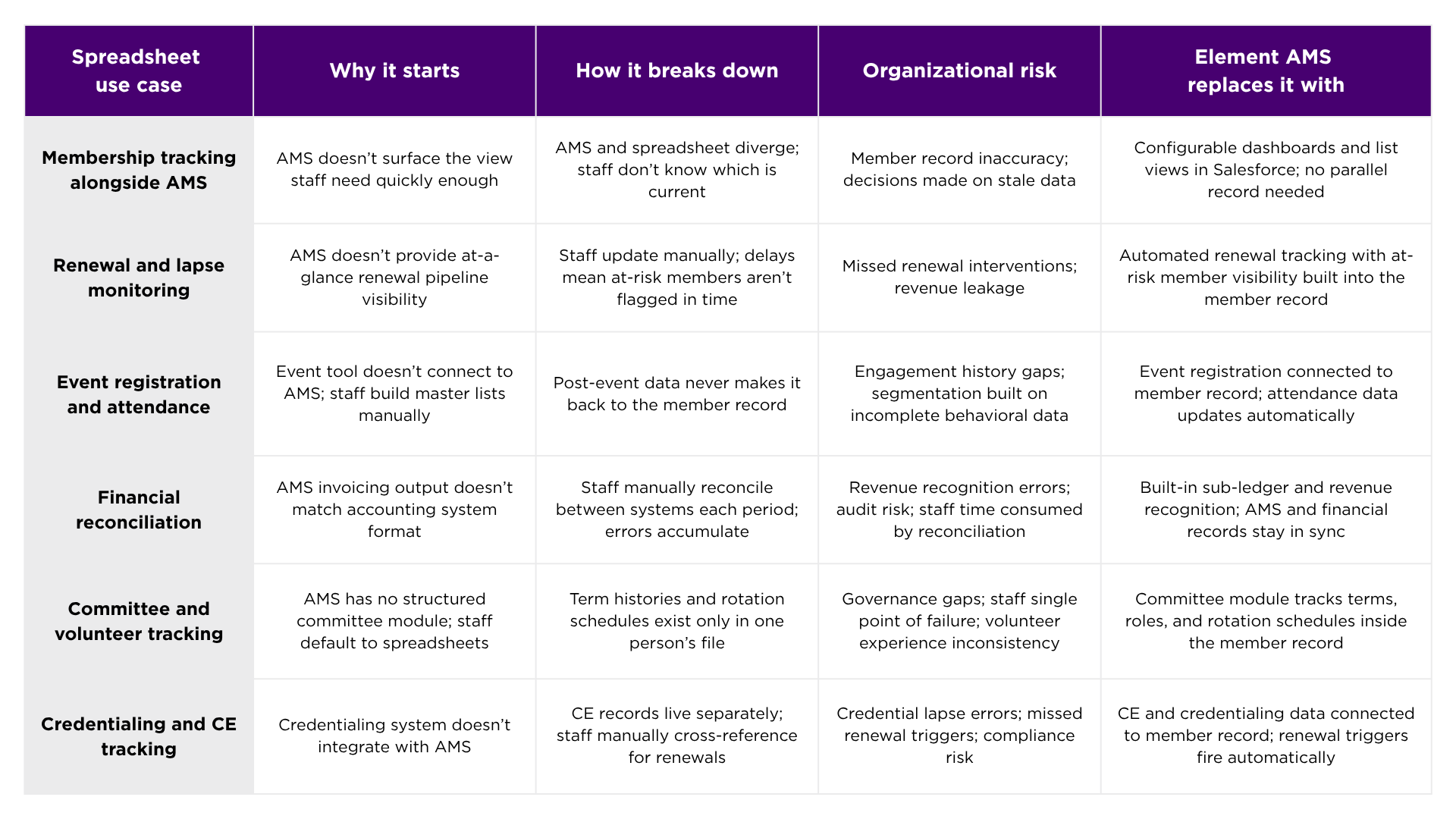
The pattern across all six workflows is consistent: the spreadsheet starts as a reasonable response to a real gap. It becomes a risk when the organization depends on it for accuracy, continuity, or compliance without acknowledging that it exists entirely outside the system of record.
The Hidden Cost of Running on Parallel Systems
The visible cost of spreadsheet dependency is version control risk. The less visible costs accumulate more quietly and are harder to attribute to the right source.
Staff Time
Every spreadsheet that has to be maintained, cross-referenced, and reconciled with the AMS is time that isn’t going toward member-facing work. For associations managing several parallel spreadsheets across membership, events, finance, and governance, that reconciliation burden is significant. It rarely appears in how staff time is allocated or measured, which means it tends to grow without being named.
AI and Reporting Readiness
Data that lives in spreadsheets cannot be used by AI tools. AI-powered segmentation, behavioral targeting, and predictive renewal modeling all depend on data being in the AMS—connected to the member record, current, and queryable. Associations investing in AI tools while maintaining parallel spreadsheet systems are restricting what those tools can do before they have started. The prerequisite for AI to work on association data is that the data lives where AI can reach it.
Audit and Compliance Exposure
Financial reconciliation spreadsheets, credentialing tracking files, and governance records that exist outside the AMS create audit exposure. When a discrepancy surfaces, there is no system of record to resolve it against. The spreadsheet may be the only source of truth for a transaction or a credential status—and if it was maintained by one person over several years, its accuracy is not something anyone can verify with confidence.
Onboarding and Continuity
Every spreadsheet is institutional knowledge that lives in a file. New staff cannot access it intuitively, cannot trust it fully without a handoff, and cannot maintain it without understanding decisions that were made before they arrived. Associations that have lost a long-tenured staff member understand exactly how much of the operation depended on files only that person fully understood. Rebuilding that knowledge from scratch is among the most disruptive and underestimated operational costs an association can face.
What an AMS Needs to Do to Make Spreadsheets Unnecessary
Most associations maintain spreadsheets because the AMS doesn’t give them a better option. Four capabilities determine whether an AMS closes those gaps or continues to generate workarounds around them:
1. Configurable Views and Dashboards That Surface What Staff Need
If pulling a renewal pipeline, a lapsed member list, or a committee roster requires a report request or a custom query each time, staff will build a spreadsheet instead. An AMS with configurable list views and role-appropriate dashboards eliminates the retrieval gap those spreadsheets fill.
2. Connected Modules That Write Back to the Member Record
An AMS with connected event, credentialing, committee, and financial modules—where activity in each module updates the member record automatically—closes the most common sources of data fragmentation.
A system where modules share a data layer is fundamentally different from a system where modules produce exports that have to be reconciled with each other.
3. Built-In Financial Infrastructure
Staff build the bridge manually, period by period. An AMS with a built-in sub-ledger and revenue recognition capability keeps billing and financial records in sync without that manual reconciliation step.
4. Native Governance and Committee Tracking
An AMS with native committee management, including term tracking, role assignments, rotation schedules, and meeting records, gives staff a structured place inside the system to handle governance.
Element AMS for Associations Ready to Retire Their Spreadsheets
For associations where spreadsheets have become load-bearing, the productive question is not “how do we maintain these better?” It is: what is the AMS failing to do that the spreadsheet is compensating for? That gap is the diagnostic starting point for understanding what the right system needs to provide.
Element AMS consolidates member data, financials, event management, credentialing, committee tracking, and operational workflows inside Salesforce. The modules connect to each other and write back to the member record, which means the parallel files that exist because systems don’t communicate stop being necessary. Staff work in one place. The data stays current without reconciliation. And the institutional knowledge that used to live in files lives in a system that any staff member can access.
See how Element AMS replaces parallel spreadsheet systems with connected association operations.
Frequently Asked Questions
Why do associations still use spreadsheets alongside their AMS?
Associations maintain spreadsheets alongside their AMS when the AMS doesn’t provide the view, workflow, or module that staff need to do their work. The spreadsheet starts as a practical gap-filler and becomes load-bearing over time—a critical operational file that exists entirely outside the system of record. Its presence is a signal that the AMS isn’t covering what it should.
What are the risks of managing association operations in spreadsheets?
The primary risks are version control failures (when the same data exists in both the AMS and a spreadsheet, the two will diverge and staff won’t know which is current), staff single points of failure (the person who built and maintains the spreadsheet is the only one who can work with it reliably), and data gaps that compound over time (information captured in spreadsheets rarely returns to the member record and cannot be used for reporting, segmentation, or AI). Each risk grows harder to resolve the longer the spreadsheet stays load-bearing.
How does an AMS replace spreadsheets?
An AMS replaces spreadsheets by providing native functionality for the workflows those spreadsheets currently handle: configurable dashboards that surface what staff need without custom queries, connected modules that write activity back to the member record automatically, built-in financial infrastructure that eliminates reconciliation files, and governance tracking that gives staff a structured place inside the system to manage committees and volunteers. The spreadsheet becomes unnecessary when the system does what the spreadsheet was compensating for.
What is a staff single point of failure in association operations?
A staff single point of failure occurs when critical operational knowledge lives in one person’s files, processes, or memory rather than in a shared system. In associations, this most commonly appears as spreadsheets built and maintained by one staff member whose departure leaves the organization without reliable access to the data or a clear understanding of how it was structured. Moving that data into a shared AMS eliminates the dependency on any single person to keep it accurate and accessible.
How does spreadsheet dependency affect association AI readiness?
Data that lives in spreadsheets cannot be used by AI tools. AI-powered segmentation, behavioral targeting, and predictive renewal modeling all depend on data being in the AMS—connected to the member record, current, and accessible to the systems that run on top of it. Associations maintaining parallel spreadsheet systems are limiting what AI can do before those tools are even deployed. Consolidating data into the AMS is the prerequisite for AI to work on it.