

All Blogs » Your Members Don’t Feel Known. Here’s the Data Behind Why.
Your Members Don’t Feel Known. Here’s the Data Behind Why.

Only 17% of association members describe the communications they receive as “highly relevant,” according to the American Society of Association Executives (ASAE) 2026.
The instinct is to respond with better content: stronger subject lines, sharper copy, a tighter editorial calendar. Those improvements matter, but they only address the surface of a problem that sits a level deeper.
Members don’t feel known because most associations are working from an incomplete picture of who their members are. Job title, geography, and membership tier describe a member’s category. They say nothing about goals, engagement patterns, or where someone is in their professional journey. Category-level data produces category-level communications — and members feel the difference.
This article breaks down where the data gap comes from, what closing it requires, and what the right systems need to do.
The 17% Problem: What the Relevance Gap Tells Us
When 83% of members don’t find association communications highly relevant, the failure is at the segmentation layer before it is at the content layer. The communications may be well-written. They may feature relevant topics and clear calls to action. But if they are built on demographic data alone, they are targeted at a category of person rather than at a specific member – and members feel that distinction.
Most associations build communications on demographic data because it is what’s available: job title, employer, geographic region, membership type. These fields exist in every AMS, they are easy to query, and they produce segments that appear meaningful at the planning stage. The gap between what the segments promise and what they deliver becomes visible only when response rates, engagement metrics, and retention data are examined against what members were sent.
Demographic data describes a member’s category at a point in time. It says nothing about what the member is trying to accomplish, what they engaged with last quarter, whether they are getting value from their membership, or whether they are approaching a lapse. Communications built on that data can speak accurately to a membership type. They cannot speak to a member.
Associations that cannot articulate a compelling value proposition to themselves are unlikely to communicate one persuasively to their members because they are not using the data that would tell them what their members value most. The relevance gap is a data gap. Closing it requires a different kind of information than most AMS systems are built to capture, store, and surface.
Why Demographic Segmentation Has a Ceiling
Demographic segmentation has legitimate uses. It is the right starting layer for broad communications, event promotions, and new member onboarding when no other data is available. However, many associations treat it as a complete strategy rather than a foundation. Job title tells you what someone does for a living, not whether they have logged into the member portal in the past three months, whether they attended the last annual conference, or whether they are six weeks from lapsing because they never found the benefit they joined to access.
ASAE 2026 research found that psychographic campaigns outperform demographic campaigns by 87%. The performance gap is that significant because psychographic and behavioral data captures intent and investment, not just category. A member who joined to build credentials and a member who joined for peer community may share the same job title and membership tier. They have almost nothing else in common from a communication standpoint.
The ceiling on demographic segmentation shows up most consistently in two scenarios. In new member onboarding, demographic data can tell you that someone joined as a clinical director. It cannot tell you whether they joined to build credentials, find community, or access research. Without that context, onboarding communications are generic by necessity, and generic onboarding is one of the strongest predictors of early disengagement.
In renewal risk identification, demographic data is essentially silent. Behavioral data like declining portal logins, no event registrations, or last content access more than six months ago, is what tells you a member is drifting before they are gone. Associations outperforming their peers on engagement have shifted what they segment on, not just how they write to those segments.

The 90-Day Window: Why Early Engagement Determines Long-Term Retention
Members who don’t engage within their first 90 days carry a 73% higher churn rate (ASAE 2026). That figure is significant because it means retention decisions are being made in a window most associations are not actively managing.
The first 90 days are when a member tests whether joining was worth it. If they cannot find what they came for like a specific benefit, a community, a credential pathway, or a resource library, they disengage. The disengagement can go undetected: no cancellation, no complaint. Just declining activity until dues renewal arrives and the decision is made. By the time a low renewal rate signals the problem, the 90-day window closed months ago.
Three operational failures make this window difficult to manage. The first is no visibility into early engagement signals. If staff cannot see whether a new member has logged in, attended anything, or accessed a benefit in the first 30 days, there is no opportunity to intervene before the pattern sets in. The second is onboarding sequences that are not personalized to join reason. A member who joined for credential pathways and a member who joined for peer community face the same early disengagement risk if they receive identical onboarding communications.
The third is no trigger-based follow-up. Most associations run time-based onboarding sequences — day 1, day 7, day 30 — rather than behavior-based ones triggered when a member’s first login has not happened by day 14, or when no benefit has been accessed by day 21. Managing the 90-day window requires engagement data captured in real time, connected to the member record, and surfaced to the staff or automated systems that can act on it. That combination does not exist in associations running disconnected platforms.
The Five Types of Member Data and What Each One Can and Can’t Do
Associations typically work with some combination of the following five data types. The table below maps what each one can support and where each one leaves gaps that affect the relevance of member communications.
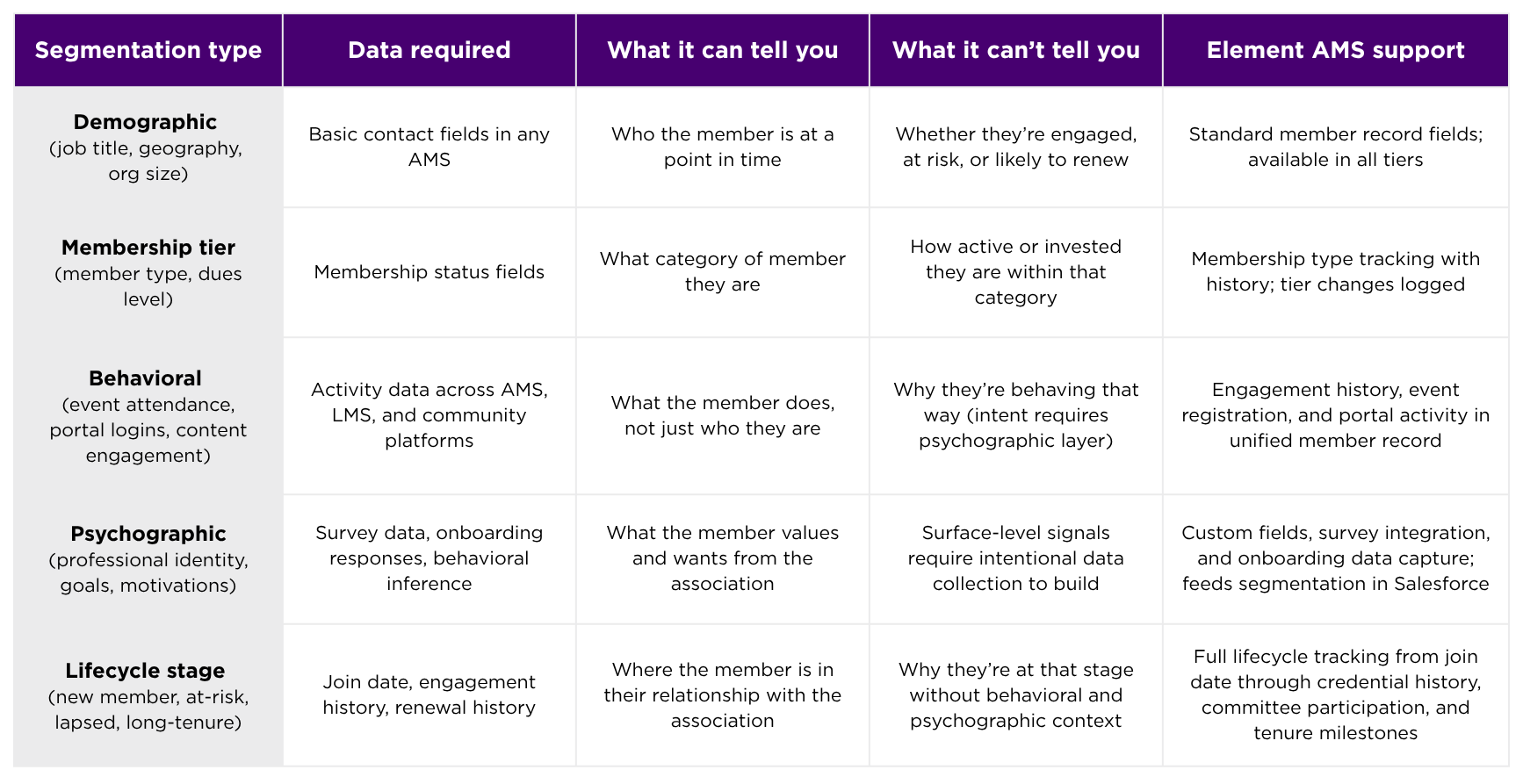
The picture the table reveals is consistent across most associations: strong demographic and membership-tier data, partial behavioral data (usually captured from the email platform rather than from the AMS or LMS), and limited psychographic or lifecycle data. The result is a communications layer that is accurate at the category level but blind to the signals that predict engagement and retention.
What It Takes to Make Member Communications Feel Relevant
Closing the relevance gap requires four operational conditions working together. Having one or two without the others produces marginal improvement. The combination is what produces communications that members experience as being directed at them specifically rather than at their job title.
1. A Unified Member Record That Includes Behavioral History
Communications built on a complete member profile have the raw material to be relevant. That profile needs to include not just contact information and membership tier, but event attendance, portal logins, content downloads, committee participation, and CE completion. Communications built on contact fields alone cannot achieve relevance regardless of how well they are written.
Unification is the prerequisite step. If behavioral data lives in a separate LMS, a community platform, or an email tool that does not sync to the AMS, it cannot be used for segmentation at the moment of communication. The data may exist; it just cannot be reached when it matters.
2. Lifecycle Stage Visibility
Members at different stages of their relationship with the association have different needs and respond to different messages. A new member in month two needs different content than a 10-year member approaching certification renewal. Lifecycle stages as tracked from join date through tenure milestones, credential history, and engagement patterns is what makes that distinction actionable rather than theoretical.
3. Onboarding Data That Captures Intent
The most direct way to close the psychographic data gap is to ask members what they joined for and capture that response in a field that connects to the member record and feeds segmentation. Associations that ask a single onboarding question “what are you hoping to get from your membership?”and route the answer into the AMS have a richer segmentation layer from day one.
The data is only useful if it is captured in a connected field. A survey response that lives in a survey tool and never reaches the AMS produces insight for a report rather than input for segmentation.
4. Early Engagement Signals Surfaced Before the 90-Day Window Closes
Engagement data is useful only if it is visible in time to act on it. Associations need to know, within the first 30 days of a new membership, whether the member has taken any meaningful action and a mechanism to trigger outreach if they have not. A monthly export from the email platform is not sufficient for this. Real-time behavioral data in the AMS, connected to automated workflows, is what makes early intervention possible before the 90-day window closes.
Element AMS for Associations Working to Close the Relevance Gap
For associations where the 17% figure feels familiar, the question worth asking is: what data are we missing, and where is it? In most cases, the behavioral and lifecycle data exists somewhere in the system. The problem is that it is not unified in a way that makes it usable for communication at the moment of segmentation.
Element AMS gives associations a unified member record that includes engagement history, lifecycle stage, event participation, committee involvement, credential tracking, and payment history — all on Salesforce, all accessible to the segmentation and communication tools associations are already using. When that data is complete and connected, communications built on it feel different to members.
See how Element AMS supports behavioral segmentation and lifecycle tracking.
Frequently Asked Questions
Why do members feel disconnected from their associations?
The most common cause is that association communications do not reflect what members care about individually. Most associations segment by job title, geography, or membership tier, but data that describes a member’s category but says nothing about their goals, engagement patterns, or professional stage. When communications are built on category data alone, they feel generic to members who expect the association to know them more specifically than that.
What is the difference between demographic and psychographic segmentation for associations?
Demographic segmentation groups members by observable attributes: job title, employer, geography, membership type. Psychographic segmentation groups members by motivations, goals, and professional identity, essentially what they are trying to accomplish and why they joined. ASAE 2026 research found psychographic campaigns outperform demographic ones by 87%, primarily because they speak to what members value rather than what category they belong to.
How do associations improve member engagement in the first 90 days?
The highest-impact changes are about visibility and trigger timing. Associations need to know, within the first 30 days of a new membership, whether the member has logged in, accessed a benefit, or attended anything, and have a mechanism to reach out if they have not. Members who do not engage within 90 days have a 73% higher churn rate (ASAE 2026). Early engagement is the most cost-effective retention intervention an association can make, and it requires behavioral data in the AMS rather than a monthly export from the email platform.
What data should associations collect during member onboarding?
At minimum: join reason (what the member is hoping to get from their membership), professional stage (early career, mid-career, senior), and primary interest area. These three data points enable the psychographic segmentation layer most associations lack. Capturing them in a field connected to the AMS member record, rather than in a survey that does not feed back into the system, is what makes the data usable for ongoing communication rather than a one-time report.
How does an AMS support member personalization?
An AMS supports personalization by providing a unified member record that includes behavioral history alongside contact and membership data. When event attendance, portal logins, content access, CE completion, and committee participation are all visible in the same record, segmentation tools can work from those signals rather than demographic fields alone. The AMS is the data layer; personalization is what becomes possible when that layer is complete and connected.