


Element AMS for Credentialing and Event Management in Associations
All Blogs » Element AMS for Credentialing and Event Management in Associations
What associations need when credentialing and events share the same member record

Most association teams struggle with the space between credentialing and events: a certificant earns continuing education credits at the annual meeting, and someone has to manually move that attendance into the credential record before the renewal deadline. Registration pricing lives in one system, dues status in another, and the transcript sits in a spreadsheet that one staff member maintains.
Event platforms built for associations generally acknowledge the dependency: member pricing at registration, session attendance mapped to continuing education requirements, certificates issued without staff chasing each attendee. What they rarely explain is how that activity updates eligibility, renewal cycles, or certification status on the member record itself.
Multi-tier associations feel this hardest. When chapter affiliation, company roster benefits, and credential class each carry different eligibility rules, a registration recorded outside the member record turns into a reconciliation exercise, and a reporting problem when the board asks how many credentialed members attended.
This guide covers what to evaluate in three areas: credentialing workflows and continuing education tracking, event registration and attendance, and the architecture decisions that determine how much manual work your staff inherits.
How integrated credentialing workflows should handle tiers, renewals, and certification tracking
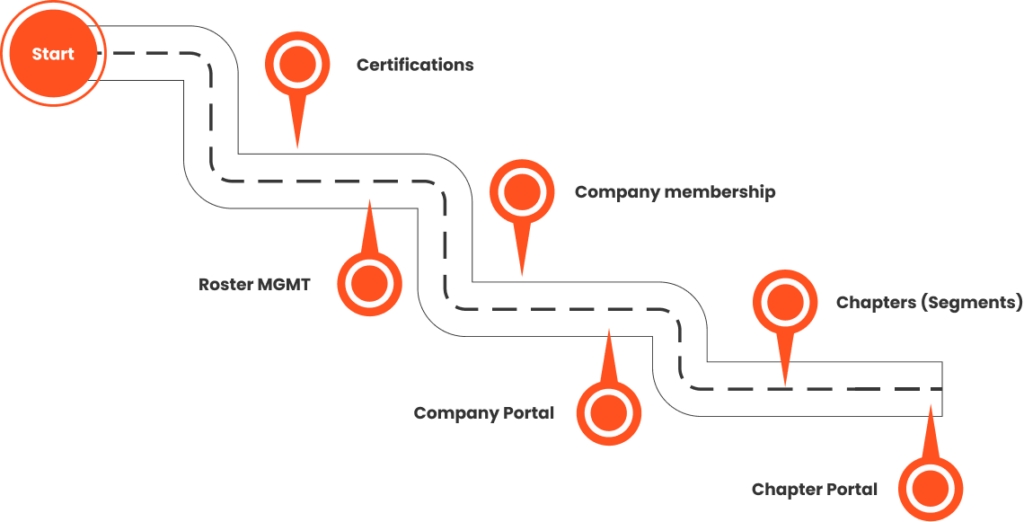
Most association credentialing problems are data problems: eligibility lives in one place, membership status in another, and continuing education credits in a spreadsheet someone owns personally. Event platforms built for conferences generally stop at attendance and certificates. X-CD, for instance, documents attendance and credit tracking, continuing education certificates, and certificates of attendance, which is genuinely more than most event tools offer. What that still leaves open is whether credit earned at the conference updates the member record that governs standing.
Multi-tier member rules
Eligibility rarely applies evenly. A full professional member may sit for certification, an associate or student member may only work toward a prerequisite, and an individual covered under a company roster may qualify through their organization’s tier. Those rules belong on the membership record as conditions the system evaluates automatically, applied the same way regardless of who reviews the application. When tier drives eligibility automatically, the answer to “can this person apply?” is the same no matter who checks.
Renewal logic
Membership periods, grace periods, and auto-renewal status all touch credential standing. A member whose dues lapse may need their credential suspended, or may be protected during a defined grace period. The policy differs by association. The workflow has to know the difference between “unpaid but inside grace,” “lapsed,” and “reinstated,” and reflect that on the credential without a separate reconciliation pass.
Certification tracking
The record needs expiration dates, accumulated credits against a required total, cycle start and end, and a current status that updates as activity posts. Session-level attendance from an event should credit the right requirement category on its own. Credit earned in November should show in a December report without anyone exporting anything.
Automated transitions
When someone moves from candidate to certified, or from active to lapsed, downstream effects follow: pricing, directory listing, badge display, renewal notices. Tying member tiers and certification tracking to one record means those effects fire consistently instead of depending on who remembered.
The alternative is familiar: staff manually validating eligibility, credits tracked outside the database, and certification status that is accurate only as of the last time someone cleaned the file. That approach works until an audit, a board report, or a credential dispute asks it to prove itself.
What event management should connect to the member record

Event software that lives apart from the member record creates a familiar pattern: registration data in one system, attendance in a spreadsheet, credits tracked by hand, and staff reconciling all three before anyone can answer a simple question about who showed up.
Start with registration and ticketing. Member pricing should resolve from the member’s current status at checkout, whether active, lapsed, in a grace period, or covered under a company roster, without staff validating eligibility manually. Whova’s guide to association event management software makes the same point about member rates being applied at registration and session attendance being tied to continuing education requirements so certificates aren’t chased down one at a time. That’s the baseline expectation, included as standard.
From there, the flow back matters more than the front end. Session-level attendance, credits earned, and certificate issuance should write to the same profile that holds dues history and credentialing status. When that connection exists, association credentialing becomes a reporting question: staff can see which members are short on credits ahead of a renewal cycle, and members can see their own progress without opening a ticket.
Engagement history belongs there too. Abstract submissions, speaking roles, committee participation, sponsor commitments, and exhibitor interactions all describe relationships your team will need next year, when you’re deciding who to invite, who to renew, and which accounts to approach for sponsorship. Kept in the event tool, that history disappears when the event closes.
Centralized event data also changes what leadership can ask for. Attendance by membership tier, revenue by event against dues revenue, repeat attendance across three years: these are straightforward reports when registrations are records in the same system as memberships, and custom work when they aren’t.
This is where event-first platforms tend to stop. Whova and Gevme both cover registration, check-in, networking, and certificate delivery well, and X-CD’s association materials list credit tracking, certificates of attendance, and proceedings archives alongside member management. What these tools are built around, though, is the event lifecycle. Element AMS handles events, memberships, credentials, committees, and accounting in one Salesforce-native data model, which is the tradeoff in the other direction: a platform organized around the member lifecycle.
Why Salesforce-native architecture changes the quality of the data and the work behind it
Architecture is a practical decision with daily consequences. It decides how many times your staff types the same certification number, how long it takes to answer a board question, and how many integrations you inherit as permanent maintenance.
Data quality starts with where the record lives
When membership, credentials, committees, and events sit on the same Salesforce-native data model, an event registration and a continuing education credit attach directly to the same member record that the association already maintains. That structure is what removes double data-entry between a registration tool and the association’s system of record, and it’s why membership-tier pricing at checkout and credit tracking after the session can share one set of rules instead of two.
Reporting is where the difference becomes visible to leadership
A shared object model means a question like “which credentialed members in our top dues tier attended zero sessions last year?” is answerable with a standard report. Event-first platforms handle their lane well. X-CD, for instance, publishes attendance and credit tracking, continuing education certificates, and proceedings archives alongside member management, and Whova’s association guidance points out that associations need member pricing at registration and session attendance tied to continuing education requirements so certificates issue without staff chasing each one. What those tools generally don’t resolve is the cross-functional view: how credentialing status interacts with renewal cycles, grace periods, and revenue recognition. That gap is a reporting problem, and it usually gets filled with spreadsheets.
Implementation fit means counting the integrations you won’t have to own
Every connector between an events system, a credentialing database, and an AMS is a thing to test after each upgrade and re-explain to a new staff member. Consolidating onto one platform reduces that sprawl, and teams already running Salesforce inherit familiar administration, permissions, and single sign-on.
The honest tradeoff: this path asks more of you upfront. A narrow event or association credentialing tool can be live in weeks with modest configuration. A Salesforce-native AMS asks you to define membership terms, credential rules, and reporting needs before go-live, and it carries real change management: staff have to learn Salesforce conventions, and you need at least one internal owner for the data foundation. If your association runs a single annual conference and no certification program, that planning overhead may not pay for itself. If credentialing, dues, and events all touch the same members, it usually does.
Where Element AMS fits best for associations with multiple member tiers
The clearest fit is an association where credentialing, events, renewals, and accounting all describe the same person, and staff are currently stitching that picture together across separate systems. If a certification lapse should affect what someone pays at event registration, and that registration should feed continuing education credit back onto the member record without anyone re-keying it, you need one data model that replaces three integrations.
That need intensifies with complexity. Multi-tier dues structures, organizational memberships with rosters that change mid-term, and certification requirements tied to recertification cycles are where spreadsheet workarounds usually appear first. Element AMS’s own materials describe memberships, credentials, committees, events, and accounting running in one Salesforce-native platform, with automated renewals, member pricing, and automated membership transitions, which is the shape of the problem those associations are trying to solve.
A narrower tool can still be the right answer. Groups running a single flat membership with one annual conference may get everything they need from a dedicated event platform. Whova, for instance, is built around attendee experience features like personalized agendas and networking, and X-CD’s association pages emphasize credit tracking, certificates of attendance, and proceedings archives. If your workflows genuinely stop at the event, that’s a lighter lift.
Element AMS becomes compelling at the point where staff need fewer manual steps and leadership needs membership, credentialing, and revenue reporting they can present without caveats.