

All Blogs » How Renewal Rates Can Reflect a Systems Issue
How Renewal Rates Can Reflect a Systems Issue

When renewal rates drop, most associations respond with more outreach: an extra email, a phone call campaign, a last-chance discount. Sometimes it works, but more often it arrives too late because the decision not to renew was made weeks or months before the renewal date.
Renewal rates are lagging indicators. By the time a low number appears in a report, the real cause has already run its course. The campaign is responding to an outcome.
Associations that consistently hold high renewal rates aren’t running better last-minute pushes. They’ve built systems that remove friction before members encounter it, surface disengagement before it becomes a lapse decision, and make renewal the path of least resistance for members who intend to stay. This article breaks down how they do it.
What Renewal Rates Are Measuring
A renewal rate is a summary of hundreds of individual member decisions, each made at a different point in the membership year. By the time it appears in a dashboard, the window to influence most of those decisions has already closed.
The real predictors of renewal show up much earlier. Whether the member engaged with any content, event, or benefit in the first 90 days. Whether onboarding was smooth or required staff intervention. Whether the member encountered friction in the portal—login problems, invoice confusion, access barriers. Whether renewal reminders reached the right contact, through the right channel, at the right time.
Research from the American Society of Association Executives (ASAE) 2026 confirmed that members who don’t engage within their first 90 days carry a 73% higher churn rate. The renewal decision is not made at renewal. For a significant share of members, it is made in month two.
The practical implication is that renewal improvement is an operational infrastructure problem before it is a communication strategy problem. The systems supporting onboarding, engagement tracking, payment processing, and reminder delivery determine renewal outcomes long before any renewal email is drafted.
What High-Renewal Associations Do Differently
Two association case studies from the 2026 ASAE MMC+Tech Conference illustrate the same conclusion through different paths: renewal outcomes are downstream of operational systems, and improving those systems produces measurable results that outreach campaigns alone cannot replicate.
Finseca: 87% Renewal Through Year-Round Engagement Infrastructure
Finseca achieved an 87% renewal rate by shifting from a reactive renewal campaign model to proactive, year-round member engagement. The change was not primarily about messaging. It was about operational visibility: knowing, at any point in the membership year, which members were disengaging—and having the system infrastructure to act on that signal before it became a lapse.
Three operational conditions made that possible. Engagement data was aggregated in a single member record rather than scattered across disconnected platforms. Automated touchpoints were triggered by engagement signals, not just calendar dates. Staff could identify at-risk members and intervene before the renewal window opened, rather than reacting after it closed.
The result was a structural shift: renewal became a year-round operational discipline rather than a quarterly campaign push.
One Case of 35% Membership Growth Through Friction Removal
The American Association of Post-Acute Care Nursing (AAPACN) addressed a different problem and reached a similar conclusion. The association saw a 35% rise in total membership after focusing on the friction that existed between members and what they were paying for. Access to development opportunities was gated behind administrative steps: approval processes, account setup requirements, manual staff involvement. When those barriers were removed, engagement increased significantly.
The AAPACN finding is direct: when members can access what they paid for without requesting permission, they use it. When they use it, they renew. Friction in the member experience carries a measurable cost in retention and revenue, even when the friction feels like a minor operational detail from the inside.
Both cases point to the same underlying pattern: renewal outcomes are downstream of systems. Associations that build the right operational infrastructure: integrated data, automated workflows, and low-friction access. Those associations consistently outperform associations that invest primarily in outreach.
Five Renewal Approaches—and Where Each One Breaks Down
Most associations use at least one of the following approaches to renewal management. Each has a ceiling, a point at which it stops working, that is almost always determined by the system limitations underneath it.
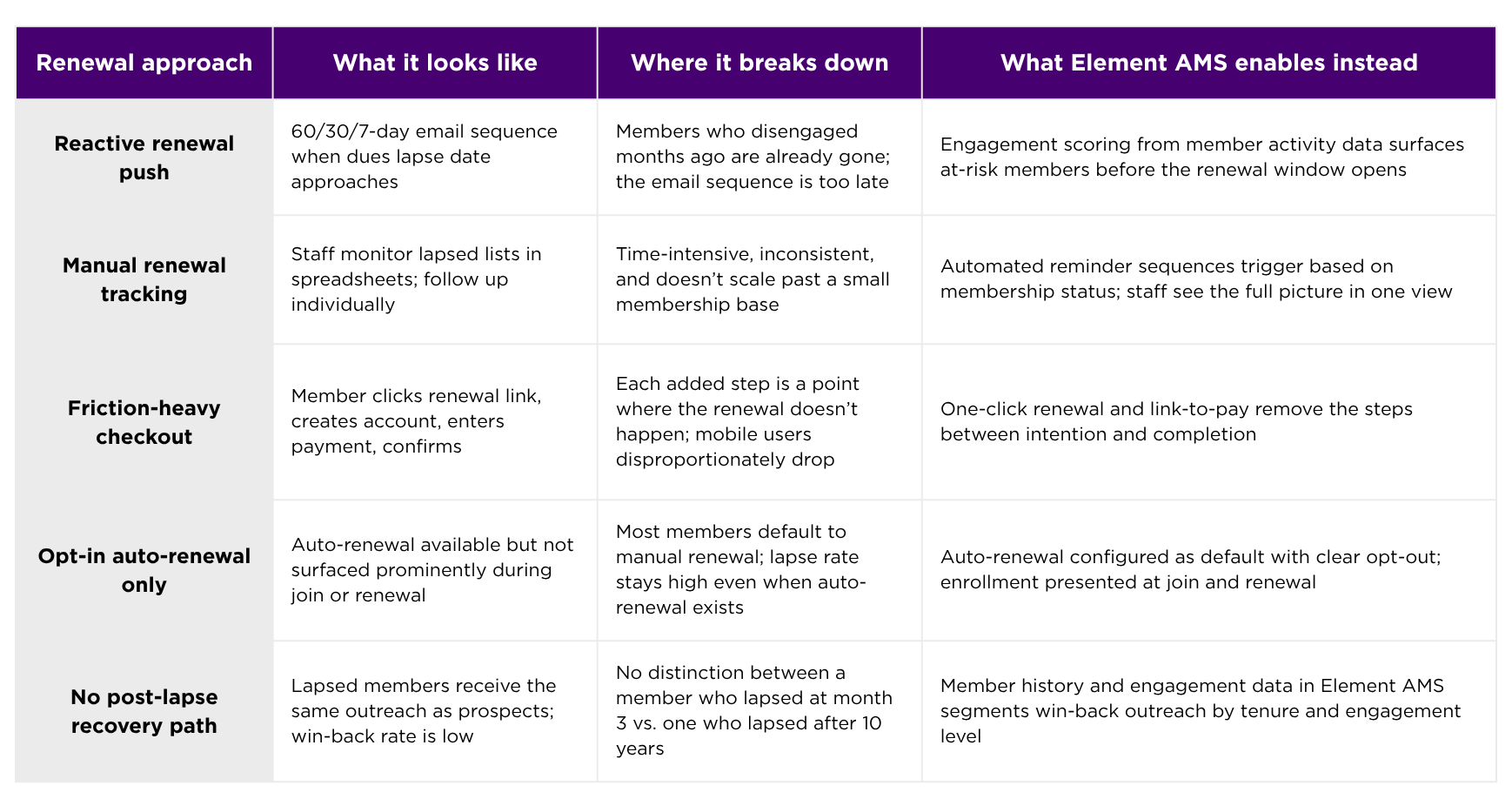
The pattern across all five is consistent: the approach fails at the point where the system can’t support it. Better messaging does not fix a broken checkout. More reminders do not recover a member who disengaged in month two. The ceiling on renewal performance is set by operational infrastructure, not outreach volume.
What Renewal-Ready Operations Look Like
Associations with consistently high renewal rates share a set of operational conditions. Four show up consistently in high-performing association data, and each one addresses a specific failure mode in the table above.
1. Engagement Visibility Before the Renewal Window
Staff and automated systems can identify members at risk of lapsing 60–90 days before their renewal date, based on engagement signals rather than dues status alone. This requires behavioral data—event attendance, portal logins, content engagement—aggregated in a single member record and surfaced in a view that makes risk visible without requiring staff to pull manual reports.
Without that visibility, the renewal window is the first moment of awareness. With it, there is time to intervene.
2. Automated, Multi-Touch Reminder Sequences
Renewal reminders go out automatically, at the right intervals, to the right contact, through the right channel. Reminders that require manual intervention to send—or that route to an outdated email address because the member record hasn’t been maintained—do not perform consistently.
Sequence timing matters at each stage: early reminders at 90 and 60 days are informational, focused on value. Mid-range reminders at 30 and 14 days are action-oriented. Final reminders at 7 days and at the lapse date carry urgency and a clear next step. Each stage requires a distinct message and a distinct call to action. Manual sequences rarely sustain this level of precision across a large membership.
3. Low-Friction Renewal Checkout
The fewer steps between a member’s intention to renew and a completed transaction, the higher the completion rate. One-click renewal, link-to-pay, and saved payment methods remove the friction that causes abandonment after the reminder lands.
Mobile is a particular exposure point. A disproportionate share of renewal abandonments happen on mobile devices, where multi-step checkout flows are difficult to complete. A renewal experience designed for desktop is leaving mobile renewals incomplete—and most members won’t return to finish on a different device.
4. Auto-Renewal as a Configured Default
Auto-renewal eliminates lapse risk for members who intend to stay but do not act. Associations with high auto-renewal enrollment consistently outperform those that treat it as an opt-in feature—particularly for members who renew habitually and would do so automatically if given the option at the right moment.
Configuration matters here. Auto-renewal presented prominently at join, reinforced at the first renewal, and made straightforward to manage—not just easy to cancel—drives higher enrollment. Members who enroll in auto-renewal at join are significantly less likely to lapse than members who are offered it as an afterthought at renewal.
Element AMS for Associations Working on Renewal Performance
For associations where renewal rates are a persistent concern, the question worth asking before the next campaign is: what in the system is producing this outcome?
Element AMS provides the operational infrastructure that renewal performance requires: engagement data in a unified member record, automated renewal reminder sequences, one-click payment and link-to-pay, and auto-renewal configuration, all within the same Salesforce-native platform that runs the rest of membership operations. When the infrastructure is right, renewal performance follows from it rather than depending on outreach to compensate for what the system can’t do.
Frequently Asked Questions
Why do associations have low renewal rates?
Low renewal rates almost always trace back to one of three sources: members disengaged early and did not find enough value to stay; friction in the renewal process caused abandonment before the transaction completed; or renewal reminders did not reach the right person at the right time. The renewal rate is a lagging indicator—by the time it appears in a report, the cause is typically months old and no longer addressable through outreach alone.
What is a good membership renewal rate for associations?
Renewal rates above 80% are generally considered strong across most association types. Associations with high-tenure memberships and year-round engagement programs—like Finseca, which achieved 87%—typically combine proactive engagement infrastructure with low-friction renewal checkout and auto-renewal enrollment. Associations operating below 70% are usually experiencing a combination of early disengagement and checkout friction rather than a single root cause.
How can associations improve member renewal rates?
The highest-impact changes are operational rather than communicative. Identifying at-risk members before the renewal window opens (using 90-day engagement data), removing friction from the renewal checkout, and configuring auto-renewal as a default rather than an opt-in each produce measurable improvement. Additional outreach—more emails, discounted pricing—is less effective when the underlying system is not supporting the renewal process at each stage.
What is the difference between renewal rate and retention rate?
Renewal rate measures the percentage of eligible members who renew within a defined period. Retention rate measures the percentage who remain active over a longer window, sometimes including members who lapsed and rejoined. Both are useful metrics, but renewal rate is more immediately actionable because it reflects system performance within a specific window, making it easier to connect to operational changes and trace to specific causes.
How does association management software improve renewal rates?
AMS software improves renewal rates by automating the processes that break down in manual systems: reminder sequences that fire on time to the right contact, renewal checkout that reduces steps to completion, auto-renewal enrollment that prevents unintentional lapse, and engagement tracking that surfaces at-risk members before the renewal window closes. The improvement comes from consistency and timing that manual workflows cannot deliver reliably at scale.