


What’s the most scalable Salesforce-based AMS for a growing trade association?

Why scalability matters for a growing trade association on Salesforce

Scalability, for a trade association, means absorbing more members, more complex membership structures, and more inbound requests without adding proportional staff burden. Growth rarely breaks a system all at once. It shows up as a renewal cycle that takes three weeks instead of three days, a company roster nobody can update without staff intervention, and a simple membership question that requires a ticket to IT before anyone can answer it.
That is why Salesforce comes up at this stage. Associations evaluating a Salesforce AMS are usually leaving behind a mix of spreadsheets and point tools. The 2026 AMS buyer's guide from Associations.com notes that many associations run five to eight separate tools before consolidating onto an AMS, and each of those connections becomes a place where data quality and staff time quietly erode.
This piece looks at scalability as operating capacity rather than a feature checklist. The pressure points that tend to give way first are consistent: process bottlenecks in dues and billing, implementation risk and change management, data model limits around company memberships and credentialing, integration upkeep, and the administrative workload required to keep records clean.
With that lens, the comparison covers Salesforce-based options trade associations commonly shortlist, including Fonteva, Nimble AMS, Protech, Member365, and Element AMS.
Where growth usually breaks first: manual work, disconnected tools, and IT-dependent reporting

Growth rarely stalls because a database runs out of room. It stalls because the work around the database compounds. A trade association that processes 400 renewals a quarter can absorb manual entry, double-entry between systems, and a side spreadsheet that tracks which company rosters are current. At 4,000 renewals, those same workarounds turn into backlogs, billing errors, and members calling about dues they already paid.
The second pressure point is system sprawl. The Associations.com 2026 AMS buyer's guide reports that many associations run five to eight separate tools before consolidating. When membership lives in a CRM, invoices live in accounting, registrations live in an event tool, and renewal reminders live in an email platform, no one sees the full member record without toggling between logins and reconciling by hand. Element AMS makes the case in its own writeup on Salesforce as a platform for association growth that a Salesforce-native AMS keeps membership, events, billing, and engagement in one system rather than stitched together through integrations.
Third is reporting. If a board question about lapse rates by chapter requires a ticket to IT, leadership decisions move at the speed of the technical queue.
These pressures show up in trade association specifics: grace periods that need accurate dating, organizational memberships where benefits must flow to the right roster seats, certification records that drive renewal eligibility. So when evaluating a Salesforce AMS for scale, performance under load is only half the question. The other half is whether staff can absorb more complexity without accumulating process debt.
Implementation risk: what to check before a Salesforce-based AMS goes live

Scalability plans die in implementation. A platform that takes a year to stabilize pushes every growth initiative behind it, so the timeline a vendor commits to is a capacity decision, not a project detail. Industry guidance from i4a puts a typical association management software implementation at roughly 60 to 90 days with hands-on support, which is a useful benchmark to hold vendors against. Ask any Salesforce AMS vendor on your shortlist, whether that is Element AMS, Fonteva, Nimble AMS, or Protech, to show you the actual phase plan and the three most recent go-live dates they can reference.
Then get specific about who owns the messy parts:
- Data migration. Who maps company rosters, membership terms, grace periods, and open invoices? Who validates them, and against what record count?
- Cleanup debt. What is expected to be fixed manually after launch, and for how long? A long tail of manual corrections is the clearest signal that the data foundation was not resolved before cutover.
- Configuration ownership. Can staff adjust renewal cycles, dues rules, and reports without a vendor ticket, or does every change management request become billable work?
- Training and post-launch support. What does support look like at month six, when processes have already shifted?
Change management deserves equal attention. Associations.com notes that many associations run five to eight separate tools before consolidating, which means staff are giving up familiar workarounds and spreadsheets they built themselves. Budget time for retraining those habits. The platforms that scale well are the ones where year two requires less rework than year one, not more.
Data model flexibility for company memberships, rosters, certifications, and renewal cycles
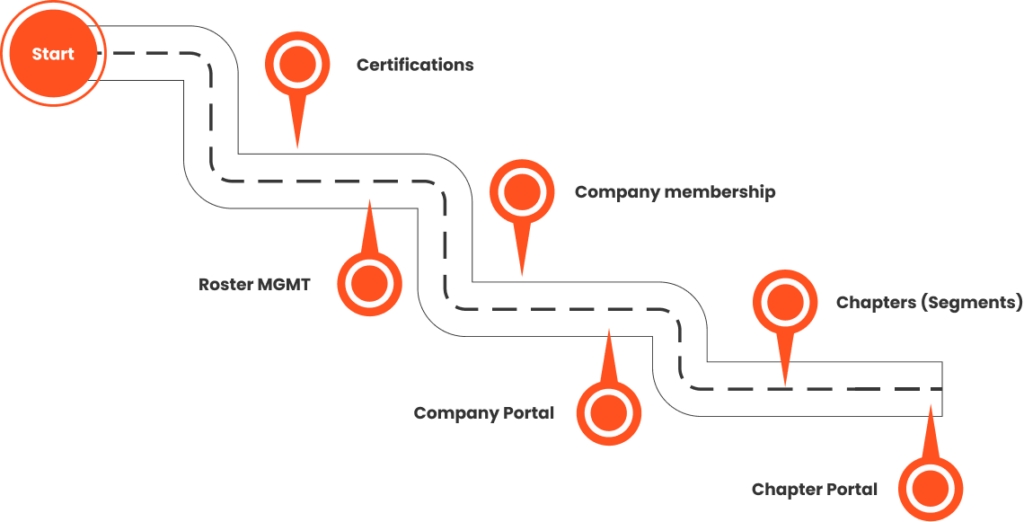
Growth usually breaks the data model before it breaks the feature list. For a trade association, the "member" is an organization: several contacts, multiple locations, parent and subsidiary relationships, roles that change, and benefit levels that vary by site. If the system treats that as one flat record with a primary contact, staff start maintaining the real picture somewhere else.
Roster management is where this shows up first. A company membership needs delegated admins who can add and remove staff themselves, seats that count correctly against a tier, and benefits that flow to the right people the moment the roster changes. Credentialing adds a second clock: certification terms, continuing education credits, and expiration dates that rarely line up with the dues renewal cycle. Add grace periods, auto-renewal, proration, mid-term upgrades, and chapter or section dues, and rigid structures force manual validation outside the database.
This is the practical difference between a general CRM layer and a Salesforce-native AMS. Salesforce supplies accounts, contacts, relationships, and custom objects, but it does not arrive knowing what a grace period, a company roster seat, or a credential renewal is. An association management system built as a managed package on the platform defines those objects and the rules between them, so configuration replaces workarounds. Fonteva and Nimble AMS are also built natively on Salesforce, and Nimble AMS in particular ships a broad prebuilt feature set that some associations can adopt with limited configuration. Protech's platform is built on Microsoft Dynamics, so confirm platform details directly if Salesforce alignment matters to your IT roadmap.
Integrations and data foundation: when one platform is enough, and when it is not
Growth rarely breaks a single system first. It breaks the connections between them. Associations.com's 2026 buyer's guide notes that many associations run five to eight separate tools before consolidating onto an AMS, and every one of those handoffs is a place where a member record can go stale, a payment can post twice, or a renewal can fire against outdated data.
Consolidating membership, dues and billing, events, and engagement history onto one data foundation removes most of that reconciliation work. Element AMS's own guidance on building associations on Salesforce argues that a Salesforce-native AMS unifies those functions and removes the synchronization problems that come with stitched-together tools. Taken at face value, the practical benefit is narrower and more useful than it sounds: fewer duplicate contacts, fewer nightly sync jobs to babysit, and fewer vendor-to-vendor conversations when something stops working mid-renewal cycle.
Consolidation has a real cost, though. A tightly unified platform means your configuration, reporting, and change management all live inside Salesforce, which assumes someone on staff or on retainer can administer it. Associations with a finance team committed to a specific general ledger, a marketing team already running a dedicated campaign stack, or a credentialing workflow with unusual rules often get better outcomes keeping those systems and insisting on well-documented, supported connections. Protech's materials describe CRM-based association management in similar terms, with association-specific tools layered onto a CRM record.
The decision worth making is a maintenance decision. Ask who owns each integration three years out, what happens when either side publishes an upgrade, and how much staff time the handoff consumes per month. A modular setup that nobody maintains ages faster than a Salesforce AMS that fewer people have to touch.
Admin workload as a scaling constraint: self-service, automation, and reporting
Growth rarely breaks a system at the database layer. It breaks at the service desk. Every address change, seat swap on a company roster, lapsed invoice question, and receipt request becomes a staff ticket, and ticket volume climbs faster than membership does.
So the practical test of a scalable Salesforce AMS is whether it removes work rather than absorbing more records. Three mechanisms matter:
Member self-service. Members should be able to update profiles, manage company rosters, pay open invoices, download receipts, and renew without contacting staff. Delegated admins at member companies should handle their own seat assignments.
Automation that protects capacity. Dues generation, renewal sequences, grace period handling, payment confirmations, and event communications should run on schedule, with multi-channel confirmation, not from a staff member working a spreadsheet each month.
Reporting people can build. Membership, finance, and leadership need to answer retention, deferred revenue, and engagement questions themselves. On the Salesforce platform that usually means report types, dashboards, and list views configured by an administrator rather than a developer ticket.
The retention link is direct. Overloaded teams create delays and billing errors, and members notice both. i4a, in its association management software guidance, points to 60 to 90 day implementations with hands-on support, which is the window where these workflows get configured correctly or do not.
Among Salesforce-based options, Nimble AMS has long leaned on Salesforce Experience Cloud for member portals, and that self-service depth is worth evaluating directly. Element AMS builds the same native pattern around company membership and billing structures, which is typically where trade associations accumulate manual work first.
How Element AMS fits a growing trade association on Salesforce
Element AMS is a managed package built on the Salesforce platform, which means membership records, dues and billing, events, and engagement history live in the same environment your staff already uses for reporting and automation. For a trade association adding chapters, certification tracks, or company rosters, that matters less as a feature list and more as an architecture decision: fewer connectors to maintain, fewer overnight syncs to reconcile, and one data foundation instead of the five to eight separate tools Associations.com's 2026 AMS buyer's guide says many associations run before consolidation.
That architecture maps directly to the scalability criteria a growing association should be testing. Salesforce objects and fields can be extended for organizational memberships and renewal cycles without a vendor ticket. Flows handle renewal sequences and multi-channel confirmation. Report builders let program staff answer their own questions instead of queuing behind IT. Element AMS's own overview of Salesforce for associations frames this as unifying membership, events, billing, and engagement in one system, and that claim is worth pressure-testing in a scoped demo with your actual dues structure.
The honest tradeoff: a Salesforce AMS asks more of you at the start. Migration, permission design, and configuration discipline take real planning, and i4a's guidance that implementation typically runs 60 to 90 days assumes clean data and decisions made on time. Fonteva and Nimble AMS are the other established names built on the same platform, and Nimble AMS's backing by a larger product portfolio appeals to associations wanting one vendor relationship across more systems.
A short framework for comparing Salesforce-based AMS options
Scalability claims sound identical across vendor sites. These five questions surface the differences, and they work equally well whether you are evaluating Fonteva, Nimble AMS, Protech, Member365, or Element AMS.
1. Data model fit. Can the system handle organizational memberships, company rosters, certifications, and non-standard renewal cycles natively, or do those structures require custom objects and workarounds? Ask each vendor to configure your actual dues structure during the demo, not a sample one.
2. Implementation risk. i4a's association management software guidance puts typical implementation at 60 to 90 days with hands-on support. Ask who owns data cleanup, how migration is staged, and what training your staff receives. The honest answer usually includes work your team must do.
3. Integration burden. The Associations.com 2026 buyer's guide notes many associations run five to eight separate tools before consolidating. List which of yours must stay connected, then ask what maintains each connection when Salesforce releases an update.
4. Admin workload. Can staff build a report, adjust a renewal sequence, or correct a billing error without a ticket to IT or the vendor? This is the constraint that tightens fastest as membership grows.
5. Change tolerance. New programs, new chapters, new credentialing tracks. Ask how each change gets made and who makes it.
Score each vendor on the same five criteria. Nimble AMS and Fonteva carry longer AppExchange track records with large associations, which matters for reference checks. Element AMS is built around configurability for complex membership and billing structures, and like any Salesforce AMS, it still depends on a clean data foundation to deliver that.
FAQ: scalability, migration, and long-term fit
What does scalability mean for a trade association running on Salesforce? Less about record limits, more about operating load. Scale shows up when a second company membership tier arrives, when rosters change mid-term, when dues billing has to pro-rate and recognize revenue across periods, and when staff need a report on Friday without filing a ticket. A Salesforce AMS scales well when those changes are configuration, not custom development. Ask any vendor to show configuration screens live, not slides.
What should we ask before migrating off a legacy AMS or a stack of spreadsheets? Start with the data model, not the feature list. Associations.com's buyer's guide notes many associations run five to eight separate tools before consolidating, so map which records are the source of truth today. Then ask: who owns data cleanup, how many membership terms and grace period rules migrate intact, what happens to historical dues and event history, and who signs off on testing. i4a's association software guide puts typical implementation at 60 to 90 days with hands-on support, which is a useful benchmark for scoping, though complex credentialing or chapter structures usually extend that.
Can a Salesforce-native AMS absorb growth in membership complexity, reporting, and automation? Generally yes, because the underlying platform handles reporting and workflow natively. Element AMS's own overview of Salesforce for associations describes a single system for membership, events, billing, and engagement that removes data synchronization between tools. The tradeoff is real: Salesforce-based platforms carry higher platform costs and need an internal administrator who owns configuration and change management.
How do we judge long-term fit? Price the next three years, not the current roster. New programs, delegated admin access, and more member self-service all land on the same data foundation. If adding a program means a vendor project every time, that is your ceiling.
If you want to see how Element AMS fits your association’s growth plans, talk to our team.