

All Blogs » Leading Organizational Transformation: Key Insights from Change Management Expert Christopher Maynard
Leading Organizational Transformation: Key Insights from Change Management Expert Christopher Maynard
Change is inevitable in associations and nonprofits—but successful change management is not. Whether you’re implementing a new Association Management System (AMS), developing AI policies, or modernizing manual processes, most transformation efforts fail not because of poor strategy, but because of inadequate change management.
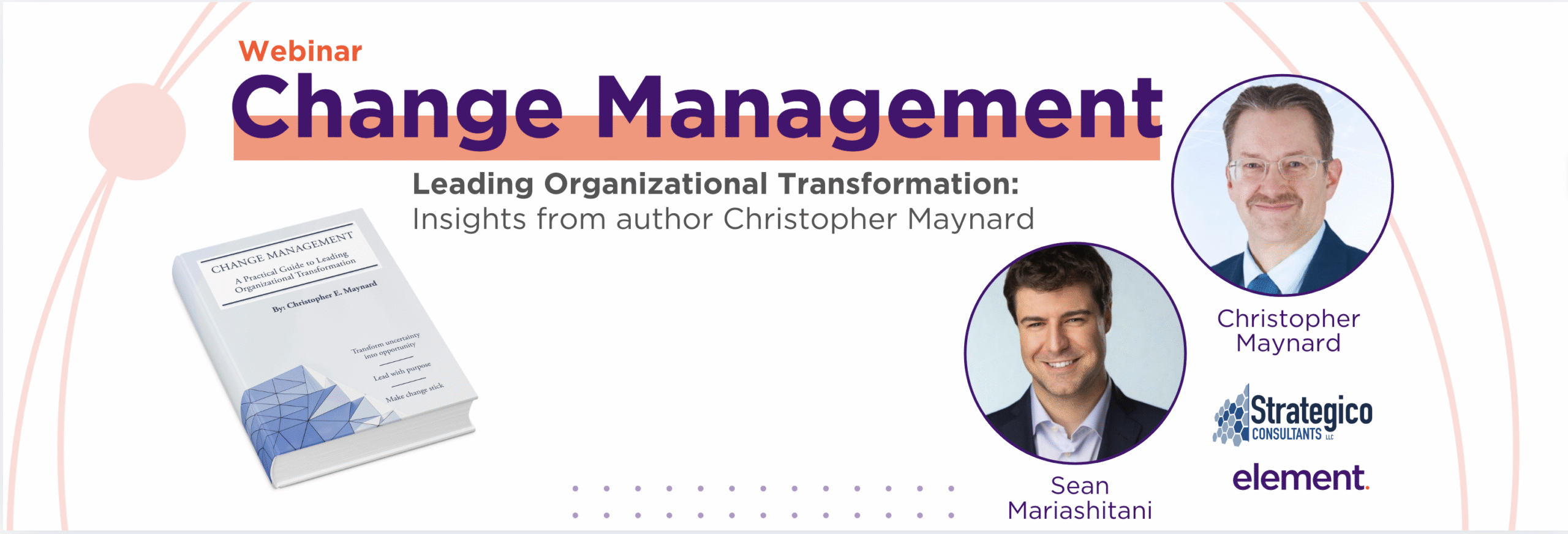
In a recent webinar, Christopher Maynard, author of Change Management: A Practical Guide to Leading Organizational Transformation and Senior CIO Consultant at Strategical Consultants, shared his expertise on leading effective organizational change. Joined by Sean Miriashtiani, Sales Executive at Element AMS, the conversation revealed critical insights for association leaders navigating complex transformations.
Expert Panel
- Sean Miriashtiani, Solution Expert at Element AMS
- Christopher Maynard, Founder of M&H Management & Consulting, and Senior CIO Consultant at Strategico Consultants
Why Change Management Matters for Associations
Change management isn’t just a buzzword—it’s a discipline, a mindset, and a commitment to doing the hard but necessary work of transformation. According to Maynard, organizations that fail to embrace structured change management principles often experience:
- Failed system implementations – Organizations approach new technology asking “how can we do it like we do today?” rather than “how can we achieve our goals more effectively?”
- Resistance from stakeholders – Without proper engagement, even beneficial changes face pushback
- Unsustainable results – Changes that don’t stick beyond initial implementation
- Wasted resources – Time and money invested without achieving desired outcomes
“Change management really demands that you consider the people affected by the change,” Maynard emphasized. “Sustainability in progress only happens when those people are engaged and supported.”
The Foundation: Leadership Commitment
The Foundation: Leadership Commitment
The first and most critical component of successful change management is leadership commitment—and it’s no accident that Maynard placed this as the opening chapter of his book.
“If you don’t have commitment from the leadership of the organization to embrace change, you’re going to have a difficult time getting everyone underneath that leadership to accept the fact that change needs to happen,” Maynard explained.
Leadership commitment isn’t just approval—it’s active championing. When CEOs, COOs, and executive directors visibly support transformation efforts, it creates a ripple effect throughout the organization. Conversely, when leadership resists change, that resistance cascades down through every level.
Real-World Example: Zero Customizations
Maynard shared a powerful example of leadership commitment in action. He worked with a client moving to a new AMS from a heavily customized system with over 800 customizations. From day one, the CEO and COO committed to a goal of zero customizations in the new system.
“We’re about to go live in just a few weeks, and we still, today, have zero customizations in the new system,” Maynard reported. “That’s the impact of approaching change management the right way—getting the right people involved, having the right conversations, and making sure everybody’s on board.”
Understanding When Associations Go Through Change
Associations face unique change drivers that differ from corporate environments:
- Technology modernization – Moving from legacy systems to modern, platform-based solutions
- AI adoption – Implementing new technologies while developing appropriate policies
- Process optimization – Eliminating manual, historical processes that no longer serve the organization
- Organizational growth – Scaling operations to accommodate new programs, chapters, or services
- Mergers and acquisitions – Combining with other organizations
- Leadership transitions – Adapting to new executive vision
The key question isn’t whether change will happen, but how organizations will manage it when it does.
Common Pain Points in Association Change Management
Throughout his consulting work, Maynard has identified several pain points specific to associations:
1. Lack of AI Policies and Awareness
Many associations are already using AI tools without formal policies governing their use, creating compliance and operational risks.
2. Historical and Manual Processes
Long-established processes often persist simply because “that’s how we’ve always done it,” even when more efficient alternatives exist.
3. Insufficient Stakeholder Engagement
Organizations fail to involve the right people at the right time, leading to resistance and poor adoption.
4. Poor Communication
Stakeholders affected by change aren’t kept informed, creating uncertainty and pushback.
5. Inadequate Resource Allocation
Organizations don’t consider both current and long-term resource needs for sustaining change.
6. Failure to Anticipate Resistance
As one webinar participant noted, anticipating resistance is one of the biggest parts of change management—yet it’s often overlooked.
When Change Becomes Chaos: Finding the Right Balance
Not all change is beneficial, and too much change can become disruptive. Maynard addressed the critical question: when does change management become chaos?
“There’s a balance,” he explained. “You have to make sure that the change you’re making is not becoming an interrupter in your business. It is important that when you’re looking at your processes, you are measuring that—trying to make a determination of, does this change really make sense? Is it really going to add value?”
The Solution: Define Your Measuring Stick
To avoid change chaos, organizations should:
- Define clear scope at the beginning of any change initiative
- Establish quantitative measures for success
- Live to that scope throughout the project
- Evaluate impacts before expanding beyond original parameters
“If you define, start out at the very beginning, defining what is the scope of what it is that we’re looking at, and you live to that scope… if it goes outside of the scope of that work, then we have to talk about what’s the impacts of that,” Maynard advised.
Making Change Stick: The Critical Success Factors
Even well-planned changes can fail if they don’t become embedded in organizational culture. Maynard identified several factors that help changes stick:
Senior Executive Champions
Beyond approval, organizations need executives who actively champion the change, communicate its importance, and model new behaviors.
The Right Tools in Place
Supporting infrastructure matters:
- Standard Operating Procedures (SOPs) – Documented processes for new ways of working
- Knowledge management systems – Wikis or internal documentation repositories
- Training materials – Resources for ongoing reference
Continuous Training and Reminders
One-time training isn’t enough. Organizations need:
- Regular refresher sessions
- Continuing education opportunities
- Reminder pathways built into workflows
- Ongoing support for questions and challenges
Evaluation and Monitoring
“Evaluation and monitoring really becomes the measuring stick as to whether or not that change was successful,” Maynard noted. Organizations should regularly assess whether changes are delivering intended results and make adjustments as needed.
Continuous Improvement
Change isn’t one-and-done. “You have to constantly be looking at it,” Maynard emphasized. “At least annually, and spread out throughout the year, but annually, look at your processes and determine, are we really… is this really doing for us what we’re trying to? Is the value add of that process still at the same level that it was? Or is there a better way of doing it?”
Change Management in AMS Implementations
Association Management System implementations represent one of the most significant changes organizations undertake—and one of the most likely to fail without proper change management.
The Customization Trap
Many organizations approach new AMS implementations by asking: “This is how we do it today, how can we do it like that in the new system?”
This approach leads to:
- Hundreds of costly customizations
- Systems that can’t be easily upgraded
- Perpetuation of inefficient processes
- Long-term maintenance burdens
The Better Approach
Strategical Consultants has been brought into multiple organizations to fix failed AMS implementations. The pattern is consistent: organizations failed to apply change management principles.
The successful approach involves:
- Discovery focused on outcomes – Understanding what needs to be accomplished, not just how it’s currently done
- Process redesign – Identifying how to achieve endpoints most effectively in the new system
- Configuration over customization – Leveraging platform capabilities rather than forcing old processes
- Stakeholder collaboration – Involving users in the journey of discovering better ways to work
Platform-Based Solutions Advantage
Maynard highlighted the benefits of platform-based AMS solutions (built on Salesforce, Microsoft Dynamics, Oracle, NetSuite):
“These configuration-based solutions allow for you to do a lot of things now that you couldn’t do before, and inherently, because of that, you now are on a path with a solution that’s going to give you more long-term capability for using the system.”
Unlike customizations that create upgrade challenges, configurations work within the platform’s framework, enabling:
- Seamless upgrades without extensive testing
- Long-term system viability
- Flexibility to adapt as needs change
- Reduced technical debt
The 22 Components of Successful Change Management
Maynard’s book breaks change management into 22 distinct components, each addressing a specific aspect of transformation. While not every component applies to every change initiative, together they provide a comprehensive framework.
Key components discussed in the webinar include:
- Leadership Commitment – Active executive support and championing
- Stakeholder Engagement – Involving affected parties in the journey
- Effective Communication – Transparent, consistent messaging
- Resistance Management – Anticipating and addressing pushback
- Resource Allocation – Ensuring adequate support for change
- Evaluation and Monitoring – Measuring success and making adjustments
- Continuous Improvement – Ongoing assessment and optimization
Each component in the book includes:
- Definition and explanation
- Key characteristics
- Impact on change management
- Tips for development
- A fictional story illustrating the concept in action
Building Buy-In Through Engagement
One of the most powerful themes throughout the discussion was the importance of stakeholder engagement—not just informing people about change, but actively involving them in the process.
“Successful change relies on good project management, but more importantly, it relies on people having ownership,” Maynard stressed. “The success of making changes in an organization is that the people who do it have some ownership in it.”
Creative Engagement Strategies
Maynard shared an innovative example from a laboratory information system implementation where staff resisted moving from a legacy system:
“We created a whole marketing theme around this. We had people submit ideas for what can our character be for this marketing thing. Ultimately, somebody had submitted, and we selected Beaker from the Muppets as our mascot for this entire project.”
The character appeared on all documentation, and stakeholders were involved in building the marketing campaign. This creative approach:
- Created excitement around the change
- Gave staff ownership in the process
- Made the transformation feel less threatening
- Built community around the shared journey
Tools for Taking the Temperature
When asked about tools for assessing staff readiness for change, Maynard recommended:
Survey Tools
- SurveyMonkey
- Google Forms
- Other survey platforms
The key is designing questions that generate quantitative data for measuring KPIs, not just qualitative feedback.
Collaborative Meetings
- Open conversation sessions about upcoming changes
- Regular check-ins with affected groups
- Opportunities for questions and concerns
Direct Engagement
- Reaching out to key stakeholders individually
- Building relationships with champions throughout the organization
- Creating feedback loops for continuous input
Measuring Success: KPIs and Performance Management
Effective change management requires clear, quantitative measures of success. As the discussion highlighted, many organizations struggle with this aspect.
The Problem with Qualitative Measures
“How happy are you on a scale of 1 to 5” isn’t enough. Organizations need true quantitative measures that demonstrate actual improvement.
Miriashtiani shared his own experience: “I wanted to show the board and my boss, hey, we put this new system in place, and we have a way for tracking attendance. But how was I showing that? I didn’t have any metrics to show it, so all I really had was, well, the kids like it. That’s not enough.”
Creating a Measurement Framework
Maynard advocates for a hierarchical measurement structure:
Corporate Performance Objectives High-level organizational goals
Department Performance Objectives Team-level goals that support corporate objectives
Individual Performance Objectives Personal goals that support department objectives
For change initiatives specifically:
- Identify what measures will determine success
- Ensure measures are quantitative, not just qualitative
- Track measures consistently
- Monitor results to determine if adjustments are needed
- Use results to inform continuous improvement
The Art of Change Management
Throughout the conversation, both speakers emphasized that change management is as much art as science.
“What you’re talking about is art. Well, change management is art also,” Maynard noted. “There’s an art to this.”
This artistic element requires:
- Adaptability – Adjusting approaches based on organizational culture
- Creativity – Finding engaging ways to bring people along
- Empathy – Understanding the human impact of change
- Communication – Translating abstract concepts into relatable terms
- Patience – Recognizing that meaningful change takes time
Miriashtiani drew parallels to his musical background: “When you’re playing an instrument, a lot of that was learning to talk in metaphors, learning to talk in very flowery, colorful language. Taking the abstract and relating it to something that we do know.”
This ability to make change relatable and understandable is critical for success.
Key Takeaways
Based on the comprehensive discussion with Christopher Maynard, association leaders should remember:
Without visible, active leadership commitment, transformation efforts will struggle. Leaders must champion change, not just approve it.
2. Anticipate and Plan for Resistance
Resistance is inevitable. Successful change management acknowledges this reality and builds strategies to address it through engagement and communication.
3. Focus on Outcomes, Not Current Processes
Especially in technology implementations, ask “what do we need to accomplish?” rather than “how do we do it today?”
4. Give Stakeholders Ownership
People support what they help create. Involve affected parties early and throughout the change journey.
5. Establish Clear, Quantitative Measures
Define success criteria upfront and track them consistently. Use data to guide decisions and demonstrate value.
6. Plan for the Long Term
Making change stick requires ongoing support: training, documentation, reminders, and continuous improvement.
7. Balance Change with Stability
Too much change creates chaos. Define clear scope and evaluate whether changes truly add value before proceeding.
8. Leverage Platform Capabilities
In technology implementations, configuration beats customization. Work within system capabilities to ensure long-term viability.
9. Communicate Consistently
Keep stakeholders informed throughout the journey. Transparency builds trust and reduces uncertainty.
10. View Change Management as Continuous
It’s not one-and-done. Regularly evaluate processes and be willing to adjust as circumstances change.
Conclusion
Change is constant in associations and nonprofits, but successful change management is a choice. By applying structured principles, engaging stakeholders, securing leadership commitment, and maintaining focus on measurable outcomes, organizations can transform effectively and sustainably.
As Maynard summarized: “Change management, it’s not just a set of tools, it’s really a mindset. It’s a discipline, and it’s a commitment to doing the hard but necessary work for transformation. It really requires clarity, courage, and especially collaboration.”
For association leaders facing AI adoption, AMS implementations, process modernization, or any significant organizational transformation, the principles outlined in this discussion provide a roadmap for success.
Resources
Book: Change Management: A Practical Guide to Leading Organizational Transformation by Christopher E. Maynard – Link to purchase
Available for purchase through major retailers. The book features 22 components of successful change management, each with practical tips, key characteristics, and fictional stories illustrating concepts in action.
Element AMS: Association management software built native on Salesforce, managing memberships, credentialing, events, committees, awards, and accounting on one platform.
Watch The Webinar
Connect with our panelists.
<

Christopher E. Maynard is a Senior CIO Consultant with Strategical Consultants and author of Change Management: A Practical Guide to Leading Organizational Transformation. With extensive experience in the association and nonprofit space, Maynard has guided organizations through complex transformations ranging from technology implementations to organizational restructuring. He is also a fiction novelist with 13 published works.
Sean Miriashtiani is a Sales Executive at Element AMS with a background in nonprofit operations and music education. His experience includes serving as Director of Operations for youth orchestras, where he managed organizational change initiatives and technology implementations.